Monday, November 22, 2010

Everything's Coming up Green Mangoes

Aamer Ombol and Aam Porar Sharbat: green mango refreshers


**Post Factum:** 
This is one of a series of posts for Vegan MoFo 2010; my theme was a 'Virtual Random Road Trip', where I used random.org's random geographic location generator to select locations around the globe, I then attempted to cook a few dishes from the traditional cuisine of that place. I didn't have a lot of time between generating the locations and coming up with recipes (~ 1 day). So, lacking time to do proper research, I can't vouch for the authenticity of anything I came up with. However, they are what they are, and it was a fun theme. 

This post couldn't be less appropriate to the local weather here at the moment. Both of the recipes are cooling summer treats, while here in the Pacific Northwest, we're having our first snow of the season.

Yet, the roadtrip happened upon Bangladesh and while searching for recipe ideas, these two caught my eye. I'm not trying to imply that the weather in Bangladesh is terribly warm at the moment. From what I can gather, April tends to be the hottest month there, while January is the coolest month with temperatures averaging in the mid-70's F. According to an online weather site, it's 84F and clear in Dhaka today. But, I digress.

I was a bit befuddled over the weekend, trying to figure out what to make for this destination...I quickly came to find that there are many regions, so many dishes: some sort of familiar, others completely new to me...Where to begin? What to do? How to begin on the path of the unititiated?

After all that, I decided to try a beverage and a cold soup, both made with green (unripe) mango. I have a confession about these recipes: I believe they are common in West Bengal, but I do not know for sure whether they are also common in Bangladesh. I'm hoping that they are...as I say, befuddled.

I'll begin with the chilled soup: Aamer Ombol – Chilled Green Mango Soup


This was my favorite of the two items. A thin, cooling soup, usually eaten as part of a meal during hot summer months, it consists of green mango, dusted with turmeric and then simmered with chili, mustard seeds, and some sugar.  If you're interested, I highly recommend reading the engaging post (with full recipe).

Note: In the recipe link above, I think she leaves out the turmeric on the ingredient list, but mentions it in the directions. I just sprinkled the fruit with a light dusting of  turmeric before adding it to the pot to simmer.


Not surprisingly, it tastes like stewed fruit, pleasantly settling on the tastebuds somewhere between sweet and slightly savory. The chili in my batch (I used 1 small chili)  was not too strong; I think I would have preferred it a little hotter. The turmeric and the mustard seeds add a mellow dimension and it turns into a mild soup with sort of a deep undertone (if that makes sense). It's easy to imagine this being very suitable and welcome in hot weather. As it was, I was happy to eat it for breakfast, amidst the snow.

The next item is called Aam Panna, or Aam Porar Sharbat (in West Bengal)


I forgot to save some mint for a garnish, (darn it), but this is a beverage made with roasted unripe mangoes, mint, cumin, black salt, and green chilis. (In case you haven't guessed, aam = mango.) It's a cool beverage, meant to be the consistentcy of orange juice rather than a thicker shake-like drink. Again, I encourage you to read through the delightful post where I found the full recipe.
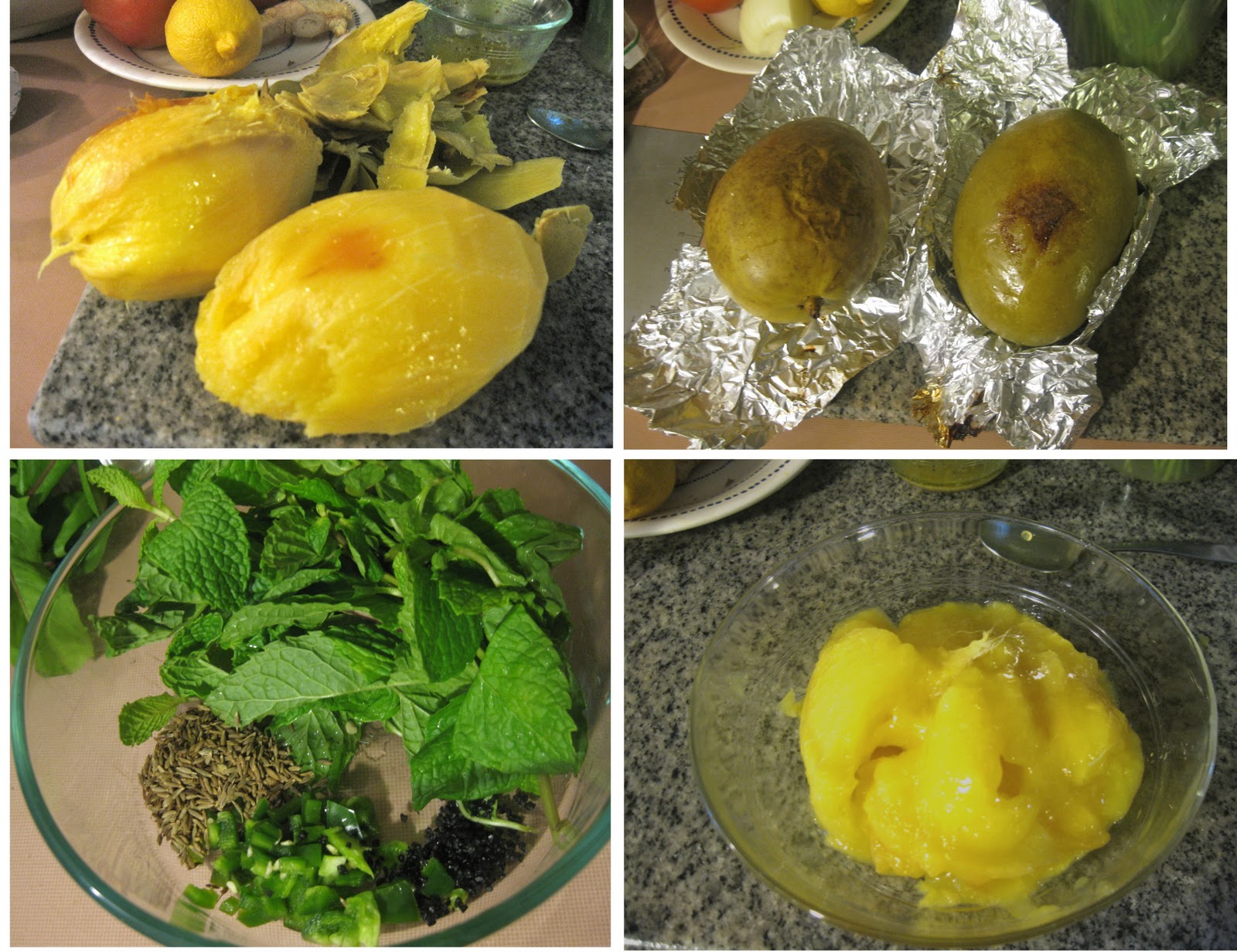

After you roast the mangoes, you remove the skins, collect the pulp and blend it with the mint and other spices, along with enough water to acheive the correct consistency. It was a fun process, and the drink is wonderfully minty. I have to say, the cumin was a bit strong for my tastes, and making this again, would reduce the amount by half. According to the recipe, using the kala namak, or black salt, is essential to the flavor.

Post scriptum: I used the wrong kind of salt! The salt I used is indeed black, but it was black lava salt, the Hawaiian kind. Oh well, next time I'll try it with real kala namak! Thanks to Laurie for pointing me in the right direction.

...Looking in on the colorful world of aam from the snow:

Friday, November 19, 2010

Pörkölt


**Post Factum:** 
This is one of a series of posts for Vegan MoFo 2010; my theme was a 'Virtual Random Road Trip', where I used random.org's random geographic location generator to select locations around the globe, I then attempted to cook a few dishes from the traditional cuisine of that place. I didn't have a lot of time between generating the locations and coming up with recipes (~ 1 day). So, lacking time to do proper research, I can't vouch for the authenticity of anything I came up with. However, they are what they are, and it was a fun theme. 

Pörkölt is a stew that (according to my very erudite source of information: Wikipedia (j/k)),  differs from  goulash in that it is braised in the oven (pörkölt means 'roasted'), instead of being simmered on the stove. The recipe I followed is flavored with marjoram and paprika, then braised in red wine. Along with goulash and paprikas, pörkölt is considered a national dish in Hungary.

It's not the traditional main ingredient for this dish (traditionally made with unmentionables), but I thought eggplant (aka aubergine) sounded good for this.  The slow cooking allows it to really soak up the flavors of the wine and spices.


The cookbook recommends a Kadarka wine to go with this, which according to this site, is a "light coloured red, normally low in tannins but has vibrant acidity, rustic and raspberry aromas, and a spicy aftertaste that makes it an ideal easy drinking wine." I used a Pinot Noir from Oregon.


Eggplant Pörkölt based on a recipe from Hungarian Cuisine: A Gourmet's Guide
(Serves 4)

1 large (or 2 medium) eggplant, chopped into large chunks
1 onion, diced
1 clove garlic, chopped fine
2 medium-size sweet peppers
1 large tomato
4 small potatoes, chopped in 1/2-inch pieces
1 cup red wine
1 cup veggie broth
1 tsp. paprika (I used sweet paprika)
4 sprigs fresh marjoram, more to garnish
salt/pepper to taste

Preheat oven to 300F (150C)

In a large stove- and oven-safe pot, saute the onions and garlic. When the onions start to look translucent,  toss in the eggplant and the peppers allow it to brown a little. Add the paprika and toss through. Add the  potatoes, tomatoes, marjoram, wine and broth, bring to a simmer, then transfer to the oven to braise uncovered for ~45 minutes. Add salt an pepper to taste. Garnish with chopped marjoram.

Ad Hoc Note: I should say that the wikipedia article states adamantly that pörkölt should not have potato...but hey, I'm a rebel...that, and the recipe I used called for them.


This smelled really lovely in the oven. The taste is rich and naturally smokey from the paprika. The eggplant is soft and flavorful as are the potatoes. It is really yummy; I'll make this again. It would also be nice garnished with a little tofu sour cream, pine nut cream, or what have you.


And in honor of it being Friday, time to slap it up and have some fun with some Hungarian folkdancing:


Oh, and one more thing, here's the next stop:


Bangladesh sounds interesting.

Wednesday, November 17, 2010

Tailor's Collar Soup or Szabógallér-leves


**Post Factum:** 
This is one of a series of posts for Vegan MoFo 2010; my theme was a 'Virtual Random Road Trip', where I used random.org's random geographic location generator to select locations around the globe, I then attempted to cook a few dishes from the traditional cuisine of that place. I didn't have a lot of time between generating the locations and coming up with recipes (~ 1 day). So, lacking time to do proper research, I can't vouch for the authenticity of anything I came up with. However, they are what they are, and it was a fun theme. 

Szabógallér-leves is a traditional Hungarian soup: "leves" = soup, and Szabógallér = tailors' collar, which refers to the triangular ravioli-esque dumplings that are in it. This is a rich broth with veggies, dumplings, and in this veganized version, baked tofu.

For this, I made two varieties of ravioli/dumpling fillings (traditionally meat) which were potato-chive-parsley, and walnut-sun dried tomato-paprika. I was torn as to which sounded better, so I made some of each. The dough is just a basic pasta dough...I always use Vegan Dad's recipe, which I highly recommend because it's easy to make and just as easy to work with.

To get started, make the dumplings:

Vegan  Szabógallér-leves Dumplings (Soup recipe follows)

(Of course, these fillings are just my suggestions...whatever mixture that sounds good to you would work.)

1 batch Vegan Dad's pasta dough

Walnut-Sun Dried Tomato-Paprika Filling:
1 cup raw walnuts
6 sun-dried tomato halves, chopped into small peices (if using dry packed ones, reconstitute them in some warm water or broth for about 30 minutes first)
pinch of salt
1/2 teaspoon paprika (use sweet or hot...whatever suits your fancy)
1/4 teaspoon garlic powder (or to taste)

Pulse all ingredients in a food processor until you get a mince-like texture.

Potato-Chive-Parsley Filling:

1 large potato
1 small handfull chives, chopped fine
1 small handfull parsley chopped fine
pinch of salt
Earth Balance or olive oil to taste

Boil the potato, then make a mash with the remaining ingredients.

Once you have your fillings and your dough made, roll out the dough to about 1/16 inch thickness. Cut out circles (~ 4-6 inches in diameter...the bigger the circle, the easier they are to make).

Cut each circle in half and place about 1 teaspoon (or more if it will fit) of filling on one side of the half circles. Make a "glue" by mixing 1 tsp flour with a little water to make a paste. Brush the pastry "glue" around the edges of each half circle. Fold the dough over lengthwise, and press the edges firmly, but gently with your fingers or a fork to seal the dumplings.


Now for the soup:

Vegan  Szabógallér-leves/Talior's Collar Soup
(serves 4)
6 cups rich veggie broth ( I used 1 cup no-beef broth, 2 cups low-sodium veggie broth, and 3 cups water)
1 medium onion, diced
1 clove garlic, chopped fine
2 carrots, diced large
1 (smallish) celeriac bulb, diced large
8 oz soy-baked tofu, cut into 1/2-inch chunks (I just marinated a few thick slices in soy sauce and baked them in the oven for ~ 10 minutes)
1 teaspoon whole pepper corns
Pinch of paprika (sweet or hot) to taste
Pre-made dumplings (see recipe above)
Salt if needed: depending on how salty the veggie broth is, you may not need to add any salt...taste and add salt if desired at the end

Saute the onion slowly over medium-low, allowing it to caramelize a little. Add in the garlic and saute for another ~ 2-3 minutes. Add in the peppercorns and veggie broth and bring up to a simmer. When the broth is simmering, add the carrots and the celeriac and continue to simmer gently. About 8 minutes before serving, gently drop in the dumplings and the tofu and continue to simmer until the dumplings float to the top. Taste for salt, add to taste if needed, and sprinkle with paprika to finish if desired.

dumplings and veggies simmering in broth
(The corner where my stove is has to be one of the darkest corners known to man.)

Note: The original recipe called for parsley root, which I didn't have. So, you may also want to add some parsley root along with the celeriac and carrot if you can find it.

This is a hearty and tasty soup; perfect for using autumn vegetables.


In doing some image searches, I see that the Hungarian capital is a beautiful city indeed:

Széchenyi Chain Bridge over the River Danube between Buda and Pest 
and the Royal Palace Buda


Matthias Church (Mátyás Templom)

Matthias Church (Mátyás Templom) by night


Budapest's Széchenyi Baths

Back in a day or two with another dish from Hungary. (All Hungarian, All the Time)
Rose Tobin Seattle
Roseann LaPonte
Rosanne Tobin
 
Related Posts Plugin for WordPress, Blogger...