Wednesday, November 3, 2010

Road Trip Day 2: Tempeh Salteñas (& some salad)

**Post Factum:** 
This is one of a series of posts for Vegan MoFo 2010; my theme was a 'Virtual Random Road Trip', where I used random.org's random geographic location generator to select locations around the globe, I then attempted to cook a few dishes from the traditional cuisine of that place. I didn't have a lot of time between generating the locations and coming up with recipes (~ 1 day). So, lacking time to do proper research, I can't vouch for the authenticity of anything I came up with. However, they are what they are, and it was a fun theme. 
Before I do anything else, I must apologize to the nation of Bolivia and salteña purists everywhere, as I'm afraid mine really don't cut the mustard. They're supposed to be juicy for a start, but I'll talk more about that later. All I can say is, be gentle; this was my first go at them and they do taste good, just a bit dry.

Salteñas are the Bolivian take on empanadas, versions of which are prevalent throughout Central and South America.  I know when I think of South American foods, empanadas are one of the first things that spring to mind. Empanadas as a recipe were brought to the Americas by way of the Spanish conquistadores, hence their ubiquitous nature throughout Central and South America.  In Spain, they are generally known as empanadillas.

Even within Bolivia these pastries vary from region to region. Some of the most acclaimed varieties being from Cochabama,  Potosi, La Paz, and Sucre. From what I can gather, the versions from La Paz and Sucre are very similar...if anyone knows for sure, please correct me if I'm wrong. The ones I've made here are the La Paz/Sucre version. They are spicy and subtly sweet at the same time, usually baked instead of fried.


The filling (typically meat) is meant to be very juicy, with raisins, olives, and boiled egg layered over the top. I used tempeh to replace the unmentionable, and that's where the lack of juiciness comes in. Typical recipes call for adding quite a lot of broth and gelatin to the mixture, allowing it to chill overnight before filling the pastry. When the pastry is filled, the filling has set up from the gelatin, and as they bake, the filling returns to it's juicy state. This is why they are meant to be eaten hot, right out of the oven before the gelatin as a chance to set up again.

For those of you following along at home, here is a list of the ingredients from the original recipe. (Please find the full recipe here.)

Salteñas Pacenas filling from Alura Gonzales: 

1 1/2 lbs. top round steak cut in 1/2 inch cubes (Sub with tempeh or similar)
1 lb. potatoes cut in 1/2 inch cubes
1 cup peas
2 cups finely chopped onions
1 tablespoon aji (hot ground red pepper)
1/2 cup sugar
1 teaspoon salt
1/2 teaspoon ground cumin (I used much more...like a tablespoon)
2 tablespoons chopped parsley
1 teaspoon oregano
1 teaspoon prepared mustard
1 tablespoon vegan Worcestershire Sauce (optional)
4 cups veggie consomme (hot) 

1 cup cooking liquid from chickpeas; it gells up when it cools.

See what I mean about all that broth and the gelatin? Now, I suppose I should have gone all out and used some vegan substitute for gelatin, but I'll leave that as a challenge for another day. In this instance, I followed the recipe as-is, substituted all the unmentionable stuff with some poached tempeh and called it a day. Which, to make a long story short,  is why they came out dry. But in my defense, they were still  tasty.


The dough also has a story. Part of the reason I chose this particular recipe was because the dough did not call for eggs, while many other versions did. I have to say, it was a bit of an odd pastry dough--more like a roll out cookie dough than anything else. And as such, came out quite crispy...and dry. But again, subtly sweet, rich, and tasty.

 filling, raisins, and olives all ready for their salteña home 
(you're supposed to use black olives, but I wanted green ones instead)

pastry rounds ready for folding
(3 raisins and 1 olive per pastry)

folded pastry (they remind me of those cute dinosaurs)

After all the heavy food lately, I felt it was time for a salad. I found this nice salad idea on a Bolivian recipe website. It's meant to be dressed with mayonaise and oil, but I thought a drizzle of extra virgin olive oil and some black pepper sufficed.

raw shredded beet and carrot, diced red pepper, red onions, and tomato


Here is some further info if anyone is interested:

I read that vegetarian versions of salteñas are not too difficult to find in cities, but I  could not find any further descriptions of what was typically in them. Here is a link to veggie friendly places in Bolivia and some other Central and South American countries: http://esperanzadelibertad.org/veggiefood.htm

Food Customs of Bolivia: http://www.boliviabella.com/bolivian-food-customs.html

Tomorrow, last day in Bolivia.

Ciao!

Tuesday, November 2, 2010

Random Roadtrip Day 1: Picante de Seitan


**Post Factum:** 
This is one of a series of posts for Vegan MoFo 2010; my theme was a 'Virtual Random Road Trip', where I used random.org's random geographic location generator to select locations around the globe, I then attempted to cook a few dishes from the traditional cuisine of that place. I didn't have a lot of time between generating the locations and coming up with recipes (~ 1 day). So, lacking time to do proper research, I can't vouch for the authenticity of anything I came up with. However, they are what they are, and it was a fun theme. 

The first day of the road trip has landed us in Bolivia, where this spicy dish would be more typically known as picante de pollo. It is a hearty dish full of flavor and very satisfying. The base of the sauce is a paste made from cumin, ground chili powder, and garlic, a combo which seems to be a prevalent flavor profile.

In perusing a few recipes, common ingredients I've come across in Bolivian cuisine include potatoes, onion, and ají peppers ( I gather there are several varieties of these peppers available in Bolivia and throughout South America. See the bottom of the post for more links/info). Some other veggies I noticed popping up regularly are  turnip, celery and tomato...not necessarily all together.

Not surprisingly, I couldn't find any ají peppers in my local shop, so I used a combination of serrano peppers and sweet long peppers. I used this recipe as a guide and came up with the following:

Picante de Seitan (Serves 4)
8 - 10 large pieces of chicken-style seitan of choice (recipe I used is below)
4 medium-sized potatoes (basically 1 potato per person), cut into 2-inch chunks
3 large carrots, cut into 2-inch chunks
1 large or 2-3 medium-sized turnips (I used 1 large rutabaga instead), cut into 2-inch chunks
1 medium onion, finely diced (~ 1 generous cup finely diced)
2 - 4  cups no-chicken broth or regular veggie broth
1 - 2 serrano peppers (depending on how spicy you want it) deseeded and chopped fine
10 small, long peppers, or 2 bell peppers of choice, cut into strips
1 cup garden peas
3 cloves of garlic
2 tablespoons ground cumin
2 tablespoons cayenne pepper or hot paprika (to make it less spicy, use sweet paprika)
salt to taste (the original recipe called for MSG, but I skipped that part)
oil for sauteeing (or whatever you like to saute with)
parsley for garnish

Liquify the cumin, ground chili pepper, and garlic with about 1/8 cup water or broth in a blender. The end consistency should be a loose paste.  In a large pan, heat a little oil and add the cumin/chili paste to aromatize it, allow to cook for 1-2 minutes, stirring frequently.

spices and garlic

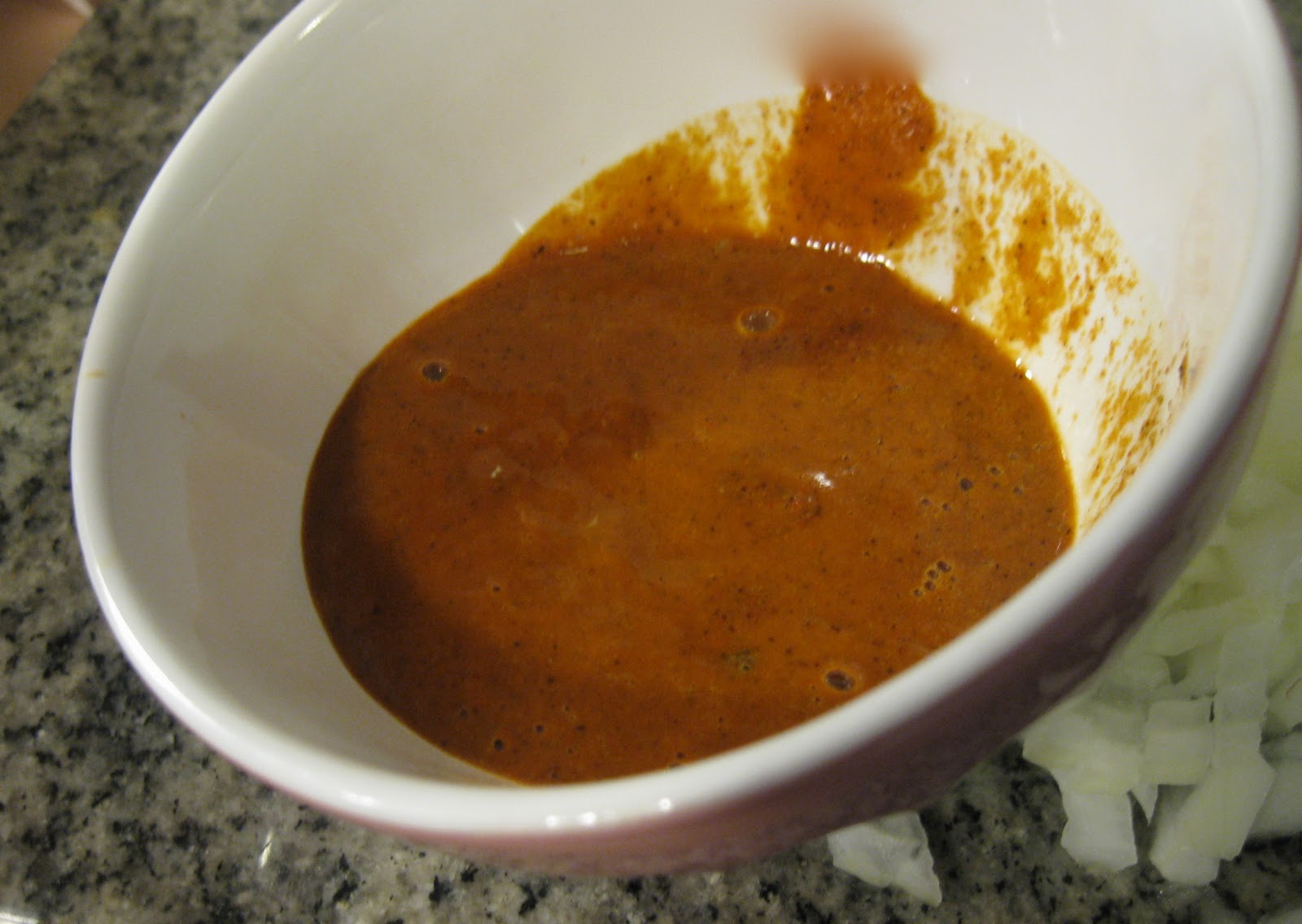
cumin/chili/garlic paste

paste aromatizing in oil

After the paste has sauteed for a couple of minutes, add in the broth, stirring it well to incorporate the paste. Then toss in the potato, carrot, and turnip chunks, bring to a simmer and allow to cook until the veggies are tender and the broth has reduced and thickened a little, ~ 30-35 minutes. Add more broth as necessary to keep veggies covered.

The potatoes should thicken the broth as it cooks, but if it gets towards the end and the broth is not thick enough for your preferences, you could always sprinkle in some arrowroot powder to get the desired consistency.

(Note: The original recipe called for cooking the carrots and turnip with the chicken, so alternately, if you're braising your own seitan, you could toss them in with that. I  chose to cook them in the spicy broth because  the seitan takes longer to cook  than the veggies, and the veggies take up loads of spicy flavor cooking in the broth.)

While the veggies are simmering, saute the peppers and seitan over medium high in a separate pan until they begin to turn golden brown. Toss in the onion and saute for another 2-3 minutes.

When the veggies are tender, toss in the browned seitan, peppers, onions, and the peas and continue to simmer for another  5 minutes.

Serve with rice (if desired) and garnish with freshly chopped parsley.

veggies simmering in spicy broth

seitan and peppers saute-ing

picante de seitan

I decided to make this post extra long (feel free to tune out if you're feeling weary) and provide the chicken-style seitan recipe I used. After a long hiatus, I have been returning to braised seitan lately. For a while, I had turned exclusively to the baked variety, which I continue to like a lot. But, I find that each type has its strengths and lends itself to specific recipes. I thought the braised variety lent itself nicely in this recipe.

Chicken-style Braised Seitan (makes 1 large piece, enough for 8 - 10 slices)

For the braising broth:
6 cups no-chicken style broth or veggie broth ( I used a combo of Edwards & Sons Not Chickn' broth and Seitenbacher's veggie broth)
1 large leek, sliced into 1-inch rounds
1 large handful of parsley
2 teaspoon celery seed
2 teaspoons garlic powder
2 bay leaves

Combine all ingredients in a large pot and bring to a simmer.

veggie broth mixes

seitan simmering in broth  (looks kinda gnarly)

For the seitan:
1 cup vital wheat gluten
1 cup low-sodium no-chicken broth, or regular low-sodium veggie broth
2 tablespoons nutritional yeast
1 teaspoon Old Bay Seasoning
1 teaspoon soy sauce or tamari (you may want to adjust this depending on how much salt is in the veggie broth you use)
1 tablespoon prepared mustard

Mix the wheat gluten, nutritional yeast, and Old Bay in a mixing bowl. Whisk together the broth, soy sauce, and mustard and add to the wheat gluten. Mix together, adding in small amounts of wheat gluten to get a consistency that you can mold into a shape and is not too wet. Form the seitan into whatever shape/s you like and drop into the simmering braising broth. Allow to simmer for 1 hour... it can simmer for longer if you like.

pre-cooked seitan (looks kind of like a brain)


braised seitan

If you're interested, here a few links to more info about ají peppers:

Seed buyer's page, includes photos of different varieties
Online catalog that sells bottled ají peppers and other chili powder products
History of ají peppers

Tomorrow, more Bolivian eats.

Monday, November 1, 2010

Random Road Trips + Halloween

The first day of November has arrived, and Vegan Mofo 2010 is already well underway. I can't wait to check out what everyone will be up to and discover all sorts of new and incredible blogs and bloggers.

My theme this year will be a random road trip. The idea is to use the random geo-location generator from random.org to generate the destinations. Basically, I'll go to the random location generator and click Pick Coordinates. This will provide me with the locations for the "road trip"--provided that the location is not in the middle of the ocean or on a polar ice cap. If you play around with the locator a little, you'll probably find that about 60 - 70 % of random locations end up being precisely in one of those places. So, I'll keep clicking until I get a land location and go with it.

I am hoping this will take me to many exotic and interesting places, but I can't vouch for the authenticity of anything I come up with...I won't have a lot of time to research each destination, but I'll do my best. And, I'll probably stick around at each location for a post or two.

Last year I somehow managed to post all 31 days, but I'm feeling a little dubious that will happen this year. I think the rules technically say that there are no official rules as to how often you need to post, but should aim for at least 5 days a week, or 20 posts in the month, which is what I'm aiming for.  At any rate, 20 posts in the month will be about 4 x more than my average.

So without any further ado, the first location is:


¡Bolivia! Tune in tomorrow for some comida boliviana.

In the mean time, here are some pics from Halloween.

Lots of vegan Halloween booty, including Yummy Earth Lollipops that come in flavors like Mango, Apple Tart, and Pomegranate. Lollipops have come a long way since I was a kid:


All tolled, we got about 15 groups of Halloween revelers...not bad compared to years passed.

Here's my favorite trick-or-treater:


Spooky porch...enter if you dare:


Of course, you need some friendly pumpkins to guide the way:

And some not so friendly ones:


How's this for an attitude? -->


Here's a little visitor, who snuck in on a flower and decided to stay for dinner:


He/she munched on that flower while we had chili in pumpkins...probably the spookiest photo of all:

That's it, ciao for now.
 
Related Posts Plugin for WordPress, Blogger...